Family budget: shared accounts, limits and roles
How to run a family budget everyone can see: shared and personal accounts, category limits, recurring bills and a monthly check-in.
· 5 min read
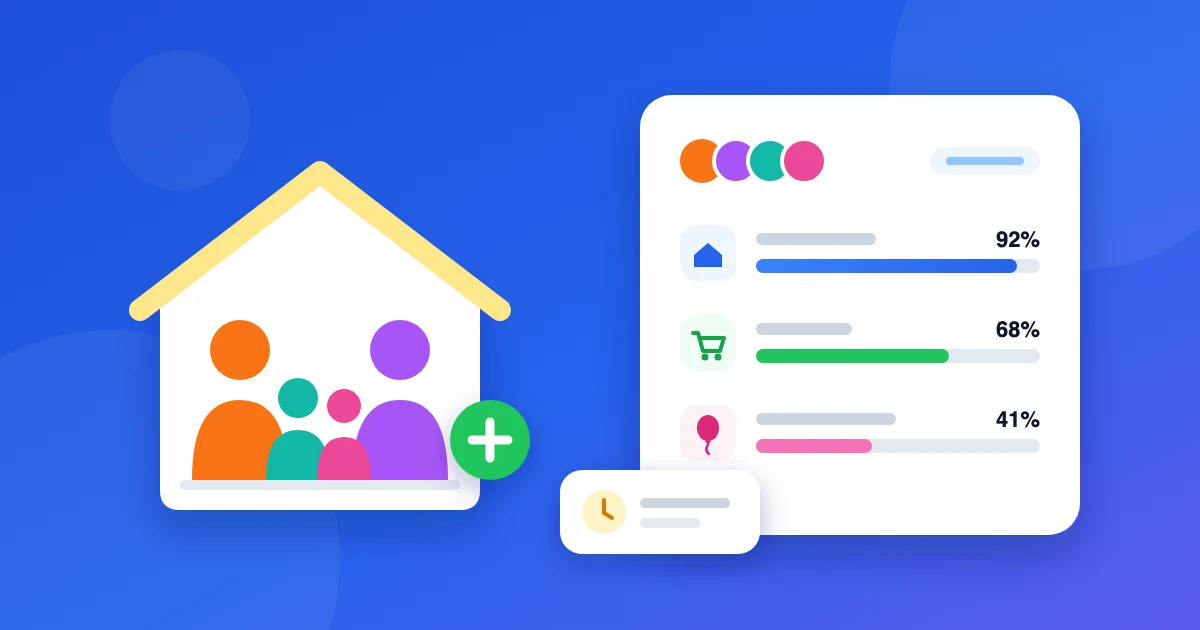
A family budget breaks down in a familiar way. One person pays for groceries, another covers the kids' clubs, a third quietly tops up a phone plan — and at the end of the month nobody can say where the money went or whether there is anything left for the summer trip.
The fix isn't a stricter spreadsheet that one person maintains for everyone. It's a shared picture that every adult in the family can see and add to in a few seconds. Here is how to set one up.
Who is in the family budget
Start with people, not numbers. Usually it is two partners, but a family budget often includes more:
- an older teenager with their own card and pocket money;
- a grandparent who helps with childcare and shops for the household;
- an adult child who still lives at home and chips in for bills.
Everyone who spends household money should be able to record it. Otherwise one person ends up chasing receipts, and the budget dies within a month.
Shared accounts and personal accounts
The key decision is which money belongs to the family and which stays personal.
- Family accounts: the joint card, the household cash, the savings for holidays and repairs, the kids' fund.
- Personal accounts: each adult's own card and savings.
Shared expenses — rent, utilities, groceries, school, the car — are paid from family accounts. Personal spending stays private: nobody needs to see what you bought for your hobby. When you move money into the family pot, record it as a transfer from your personal account to a family one.
This split removes most arguments. You stop discussing individual purchases and start discussing one question: is the family pot enough?
Categories that fit a family
Five to eight categories are enough to start:
- Home — rent or mortgage, utilities, internet.
- Groceries and household items.
- Kids — school, clubs, clothes, pocket money.
- Transport — fuel, public transport, car maintenance.
- Health — pharmacy, doctors, insurance.
- Eating out and entertainment.
- Big plans — holidays, furniture, gifts.
Resist the urge to split "Kids" into ten subcategories in the first month. Add detail only when a question comes up that the current categories can't answer.
Limits by category, not one big total
A single "we spend 3,000 a month" number doesn't tell you what to change. Limits per category do. Set them based on the last two or three months:
- monthly limits for groceries, eating out and kids' activities;
- weekly limits for categories that drift easily, like snacks and takeaways;
- quarterly or yearly limits for irregular costs — school uniforms, car insurance, gifts.
When groceries hit 80% of the limit by the 20th, everyone sees it at the same time — not just the person who happens to do the books.
Regular payments on autopilot
Families have many recurring bills: rent, kindergarten, music lessons, streaming, insurance. Each one is easy to forget and painful to miss.
Put them on a schedule once: amount, account, category and how often it repeats. Then you see what is due this week and can mark a payment as done with one tap instead of typing it again.
A monthly family check-in
Once a month, take 15 minutes together:
- Look at categories, not individual receipts. Where did we go over?
- Check the big plans. Are we putting enough aside for the summer?
- Look ahead. Birthdays, school fees, a car service — set them up now.
If you have teenagers, include them for the "Kids" and "Entertainment" part. Seeing real numbers teaches more about money than any lecture.
Common mistakes
- One "accountant" for the whole family. If only one person records expenses, the picture is always incomplete.
- Merging everything. Without personal money, people start hiding purchases.
- Judging individual purchases. Discuss categories and limits, not who bought what.
- No buffer. Keep a small "Unexpected" category for broken appliances and sudden doctor visits.
How a family budget works in Buddzy
Buddzy has a family budget built in:
- one family, up to 10 people. Invite members by email; they join with their own login;
- one subscription for everyone. Family members use the owner's Premium plan, so nobody else has to pay;
- family and personal accounts side by side. Family accounts are visible to all members, personal accounts stay private;
- you see who recorded what. Every family transaction shows its author; members can edit their own records, the owner can edit everything;
- category limits for a day, week, month, quarter or year, shared by the whole family;
- regular payments with reminders, so bills don't slip through;
- accounts in different currencies, with totals in your main currency.
The family budget is part of the Premium plan — see pricing. If you're just starting out as a couple, read our guide to budgeting as a couple.
Checklist
- Everyone who spends household money can record expenses.
- Family accounts for shared costs, personal accounts for everything else.
- Five to eight categories to start.
- Limits per category, with weekly and yearly ones where it makes sense.
- Recurring bills on a schedule.
- A 15-minute family check-in every month.
Read next
 ArticleFamily finance
How to Budget as a Couple Without Arguing
A simple shared budget for couples: what counts as shared, how to split costs fairly, joint accounts, monthly limits and a 15-minute money date.
· 4 min read
 GuideMultiple currencies
Budgeting after relocation: a guide for expats
How to set up personal finances after moving abroad: accounts in several currencies, exchanges, rent and limits. Examples for Georgia and Serbia.
· 5 min read
 GuideMultiple currencies
How to Track Expenses in Multiple Currencies
Paid in one currency, spending in two others? A simple system for tracking expenses across currencies — accounts, a main currency, transfers and budgets.
· 4 min read